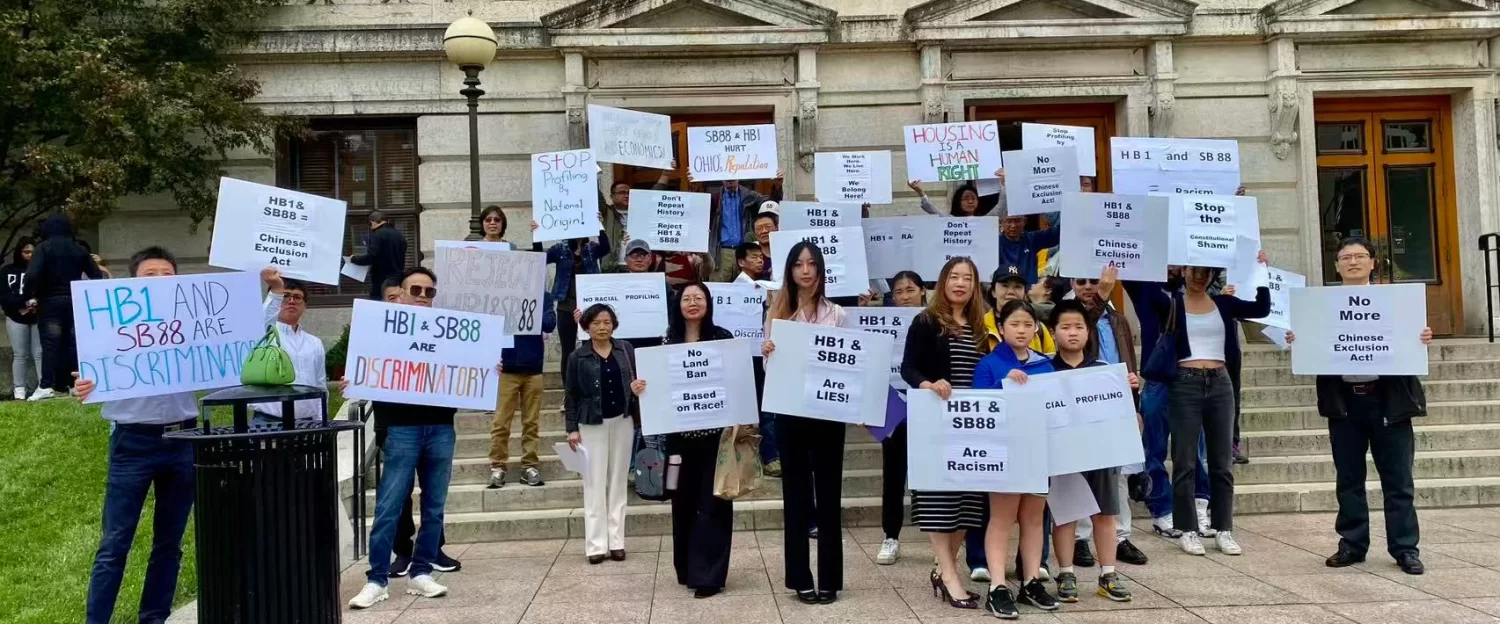


We need YOU on June 24th, sign up here to DEFEND our rights!
What are HB1 & SB88?
House Bill 1, titled the Ohio Property Protection Act, seeks to prevent foreign adversaries and their affiliates from acquiring certain real property in Ohio that is deemed strategically important. This includes agricultural land, properties near military installations, and areas close to “critical infrastructure”. The legislation prohibits individuals, businesses, and governments associated with designated foreign adversaries from purchasing or holding such “protected property.” Similarly, Senate Bill 88, also named the Ohio Property Protection Act, bars certain foreign individuals, entities, and governments from acquiring or maintaining ownership of “protected property” within the state. These properties include agricultural land and land near military or critical infrastructure sites. The bill defines key terms such as “foreign adversary” and mandates affirmations from buyers and sellers in property transactions involving protected property.
OCAA’s Position on HB1 & SB88
Issues of the Original Bills:
(1) Overly Broad Definition of “Persons” Impacted
The current definition of “persons” in the bill includes individuals and businesses, in addition to foreign governments listed as adversaries by the Secretary of State, expanding the scope far beyond the list identified by the Secretary. This broad definition risks misclassifying Ohio residents and businesses as foreign adversaries, potentially leading to discrimination based solely on national origin. Such an approach could infringe upon individual civil liberties and property rights, potentially violating federal and Ohio laws, including the U.S. Constitution’s 5th and 14th Amendments, the Fair Housing Act of 1968, and the Ohio Constitution.
This echoes the alien land laws enacted over a century ago that targeted immigrants and communities of color. It is chillingly reminiscent of some of the darkest chapters in American history—such as the Chinese Exclusion Act and the forced incarceration of Japanese Americans during World War II—when tens of thousands were compelled to sell their homes, businesses, and belongings at steep losses just days before being imprisoned without due process.
(2) Overly Broad Scope of “Protected Property”
While the bill understandably includes military bases and airports in the name of national security, it also encompasses “critical infrastructure” as defined in Ohio law addressing criminal trespassing. This definition covers commonplace utilities like water and sewage lines, telephone and electric lines, and cell towers. Imposing restrictions within a 1-mile radius of these everyday structures would significantly limit property ownership opportunities across Ohio, and the bill’s 25-mile radius requirement would make it nearly impossible for affected individuals to own property anywhere in the state.
| This expansive scope could drive immigrants and immigrant-owned businesses out of Ohio, damaging our economy. For context, Ohio is home to approximately 40,000 Asian American-owned businesses, which support 100,000 jobs and contribute $3.3 billion in wages.
|
 |
Suggested Amendments:
(1) Narrow the definition of “Persons”
Limit the scope to exclude individuals and businesses unless they are explicitly listed as adversaries by the Secretary of State. By targeting only entities directly identified as security threats, this amendment prevents discrimination based on national origin, preserves the rights of residents and businesses, and mitigates the risk of economic harm from displacing immigrants and immigrant-owned businesses in Ohio. Additionally, establish a review process to ensure the adversary list remains accurate and current.
(2) Narrow the “Protected Property” list
Remove the term “critical infrastructure” from the list due to its overly broad definition. Instead, clearly specify property types that have a direct connection to national security, such as military installations and airports. This targeted approach safeguards national security without unduly restricting property ownership in areas posing no direct threat.
(3) Strengthen National Security Through Targeted Resource Allocation
Rather than broad, discriminatory measures, focus on augmenting resources to effectively enforce existing federal laws and regulations that are already designed to protect national security. These include:
- Foreign Investment Risk Review Modernization Act (FIRRMA)
- Defense Production Act (DPA), Section 721
- Export Administration Regulations (EAR)
- Office of Foreign Assets Control (OFAC)
These targeted, evidence-based tools can protect national security without resorting to discriminatory property bans or broad, overreaching legislation.
Legislative Process
Before taking any action against these bills, its important to know the process of how these bills can work their way towards becoming law:
Introduction: A bill is introduced by a member of either the Ohio House of Representatives or the Ohio Senate and is assigned a unique number. This initial step is known as the “first consideration.”
Committee Review: The bill is referred to a relevant committee, where it undergoes detailed examination. The committee may hold public hearings, solicit expert testimony, and propose amendments. After thorough review, the committee votes on whether to report the bill favorably to the full chamber.
Floor Consideration: Upon favorable committee recommendation, the bill proceeds to the full chamber for debate and possible further amendments. This stage includes the “second” and “third considerations.” A majority vote is required for the bill to pass in its originating chamber.
Second Chamber: The approved bill is sent to the other chamber (House or Senate), where it undergoes a similar process: committee review, floor debate, and voting. If the second chamber amends the bill, it returns to the originating chamber for concurrence.
Governor’s Action: Once both chambers agree on the final version, the bill is presented to the Governor, who can sign it into law, veto it, or allow it to become law without a signature after ten days. If vetoed, the General Assembly can override the veto with a three-fifths majority in both chambers.
What we have done so far
On May 20th, over 100 people attended the 3rd hearing of House Bill 1 in the Public Safety Committee, with 68 of us submitting written testimony, and many of us presenting spoken testimony.


On May 27th, over 300 people attended the 4th hearing of Senate Bill 88 in the General Government Committee, with 308 of us submitting written testimony, and many of us presenting spoken testimony.


| Bill | House Bill 1 | Senate Bill 88 |
| Committee | Public Safety Committee | General Government Committee |
| Written Testimony | Link | Link |
| Hearing Recordings | Third Hearing Part 1 – May 20th, 2025 Third Hearing Part 2 – May 20th, 2025 |
Fourth Hearing – May 27th, 2025 |
Call, email the committee members and voice your opposition to these unconstitutional bills!